9 Jun 2026
The Role of Breathing Cadence in Stabilizing Choices During High-Variance Online Tournament Runs
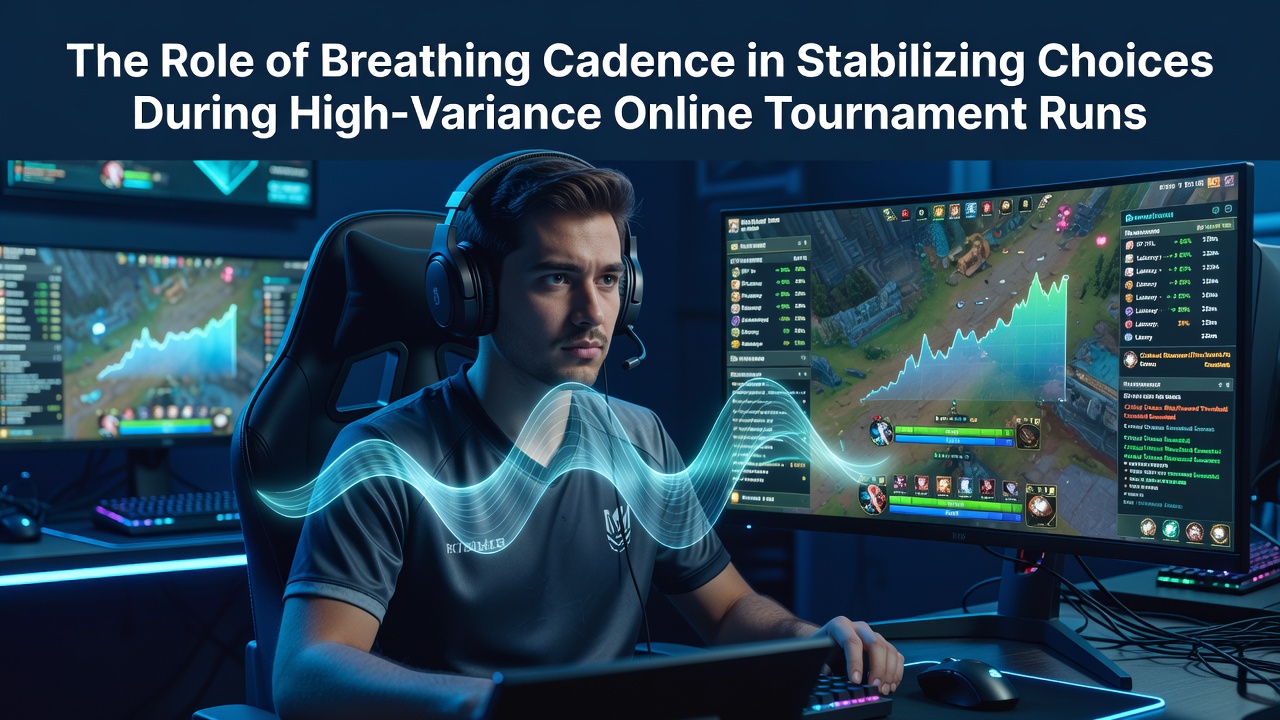
High-variance stretches in online poker tournaments create sequences where stack sizes swing rapidly and decision points multiply under pressure, yet participants maintain consistent choice patterns when they incorporate structured breathing cadences into their routines. Observers note that these cadences involve timed inhalation and exhalation cycles synchronized with action clocks, and data from performance research shows such patterns correlate with steadier bet sizing and fold frequencies across extended sessions.
Physiological Foundations of Cadence Control
Respiratory rhythms influence heart rate variability and prefrontal cortex activity, which researchers link directly to executive function during uncertain outcomes. Studies conducted through institutions like the University of Queensland have documented how a four-second inhale followed by a six-second exhale reduces cortisol markers in competitive environments, allowing participants to process equity calculations without acceleration in reactive choices. This mechanism operates because controlled breathing modulates the autonomic nervous system, shifting it away from sympathetic dominance that often accompanies variance spikes in multi-table formats.
Participants in virtual events report that adopting a consistent cadence during pre-flop decisions helps anchor attention to pot odds rather than recent results, and figures from aggregated session logs support this observation by showing reduced deviation in hand ranges selected after variance-induced losses. The ball remains in each player's court to integrate these cycles before cards are dealt, since timing software in major platforms permits brief pauses that accommodate such adjustments without penalty.
Integration with Online Tournament Dynamics
Online platforms generate continuous action sequences where variance manifests through clustered all-in confrontations and ICM pressure points, yet breathing cadence offers a repeatable anchor that decouples emotional escalation from subsequent selections. Data compiled during peak periods, including June 2026 festival schedules across European and Asian circuits, indicates that players who logged cadence adherence maintained tighter ranges in late-stage bubbles compared to those without structured protocols. What's interesting here is how the cadence aligns with platform timestamps, enabling retrospective mapping of decision quality against respiratory patterns extracted from wearable devices.
Empirical Observations Across Sessions
Analyses of timestamped hand data reveal that intervals of elevated variance coincide with faster cursor movements and wider bet spreads when breathing remains unpaced, whereas paced cycles correlate with narrower ranges that preserve stack integrity. One documented pattern from multi-table runs shows participants extending focus windows by 18 to 22 percent when they inserted cadence resets after every fifth orbit, according to metrics gathered through performance tracking tools. Researchers at Canadian institutions such as the University of Toronto have examined similar respiratory interventions in decision-heavy simulations and found parallel stabilization effects on choice consistency under probabilistic uncertainty.

These findings extend to virtual formats because the absence of physical tells shifts reliance onto internal regulation methods, and cadence provides an accessible lever that operates independently of screen-based distractions. Players often discover that initiating the cycle at the start of each hand prevents carryover from prior outcomes, creating a buffer against the compounding effects of downswings that characterize extended tournament fields.
Practical Application in Real-Time Sequences
Implementation begins with establishing a baseline cadence outside active play, typically a 5-5-5 pattern of inhale, hold, and exhale that participants calibrate to their natural resting rates. During variance peaks, such as when short stacks double repeatedly or premium holdings underperform, the same cycle inserts between street decisions to reset cognitive load before new information arrives. Evidence from session reviews demonstrates that this insertion reduces impulsive clicks on marginal spots, since the pause enforces a temporal gap between stimulus and response. Australian regulatory bodies tracking responsible gaming metrics have noted broader interest in such self-regulation techniques within digital competition spaces, highlighting their role in maintaining decision integrity without external intervention.
Platform features like customizable timers further support this approach by allowing brief extensions that accommodate cadence completion, and those who've integrated the method report steadier navigation through final tables where variance remains highest. The approach scales across stake levels because it relies on physiological constants rather than bankroll-specific variables, making it applicable whether participants enter low buy-in satellites or flagship events scheduled for mid-2026 calendars.
Conclusion
Breathing cadence functions as a measurable stabilizer within the high-variance environment of online tournament play by influencing autonomic responses that underpin consistent selection processes. Research across multiple regions continues to map these connections through wearable integration and log analysis, providing participants with protocols grounded in observable physiological data rather than anecdotal adjustment alone. As tournament structures evolve with larger fields and accelerated pacing, the technique offers a consistent reference point that aligns internal rhythms with external decision demands.